Does the beginning of your retention graph always look like this?
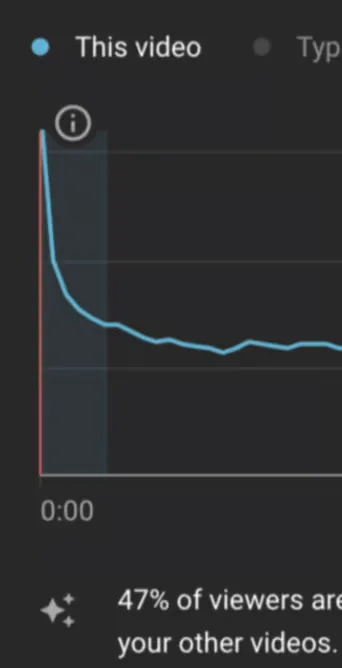
Let’s fix that!
Steal my cheat codes for killer YouTube intros that get your graphs looking like this:
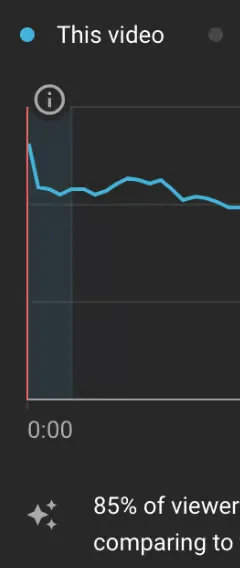
YouTube video intros are the first impression every single viewer has for your piece of content.
Make sure you get them right.
The Four S’s of Effective Intros [Mandatory]
If your intros do not include all three of these, you are shooting your video in the foot:
- Support Your Claim
- Situate The Viewer
- Sustain Attention
- Keep It Snappy
Supporting Your Claim
The first thing a viewer should see after clicking is something to support the title and thumbnail that got them to click in the first place.
There are two ways to do this:
- Visual showcase
- Verbal confirmation
- [and infinite combos of the two]
Some creators opt for a cinematic opening while others go more direct and reiterate the title within the first 2 seconds of the video. Not sexy, but it gets the job done.
We’ll dive into stylistic choices a bit further down.
Situating Your Viewer
Situating is NOT:
- An extended period of information overload
- Giving every piece of context available
- A time to outline your video
Situating IS:
- A brief time to get viewers up to speed on what they clicked on
- Giving enough context to the viewer so they don’t feel lost
- Literally “the sitch”
Picture this: your friend misses the opening scene of a movie and asks you what happened.
Do you:
a. Tell them word for word exactly what happened
b. Give them a quick summary so y’all can carry on with the film
If you answered A, please never invite me to watch a movie with you.
Sustaining Attention
Now that your viewer knows that they haven’t been clickbaited and are up to speed, give them a reason to stay.
How? Open a loop in their mind.
Sounds like some neuroscience nonsense, but it’s simple. Use the same curiosity that got them to click (that’s a later newsletter) to keep them watching.
Get your viewer to ask themselves a question:
- What will that look like?
- How is this even possible?
- What’s the final tip/trick?
From your perspective, you can:
- Set a goal
- Present an obstacle
- Tease a transformation
Regardless of your choice, the viewer should have a reason to keep their eyes on your video and not the suggested list.
Keep It Snappy
I define snappy intros as both quick and seamless.
Quick = 15 seconds or less (with exceptions)
It’s common for top creators to cram everything into the first 6-7 seconds of a video. That’s not always necessary, but remember that your content will be the biggest attention-holder.
Get there as soon as you can without leaving your audience in the dust.
Seamless = Don’t interrupt the viewer
Your intro should not feel like a completely different segment with a clear transition point. Anything that interrupts the viewer’s experience [including you] can make them leave.
Great info, Trent! But what does this look like in action?
Glad you asked.
The Four P’s of Intro Style [Situational]
Even though every intro should have the elements listed above, that does NOT mean that every intro has to be the same. There are limitless creative ways to bring an audience along for the ride.
I’ve spent more hours than I can count studying creators’ intros and these are the four most common buckets I see:
- Pacing
- Process
- Presence
- Personality
Pacing
This is the most widely known intro style and typically includes:
- Fast cuts
- Speedy dialogue
- High energy music and graphics
This style can carry a negative connotation when done in extreme measures, but it is an incredibly effective tool for setting the stage and getting an audience hooked quickly.
Examples from:
Process
Most commonly seen in listicles and how-to content, this style can include:
- Showing a starting point
- Teasing an end point
- Establishing goals
Examples from:
Presence
These intros are typically seen in adventure videos, documentaries, etc. Their goal is to bring the viewer fully into the moment, into the presence of the story. These intros are characterized by:
- Cinematic shots
- Minimal graphics
- Epic or inspiring music
Examples from:
Personality
These intros go against expectations for “typical” YouTube videos. They focus on:
- Simplicity
- Connection
- The creator’s personality (shocker)
Examples from:
And there you have it.
The best part? These are only the building blocks. The best creators mix and match to create truly unique and engaging intros.
What are you waiting for? Let’s get to work.

Written by Trent Haire
First hire at TBNR, where he helped grow eight channels from 2M to 50M+ subscribers. Now he works one-on-one with creators and entrepreneurs.